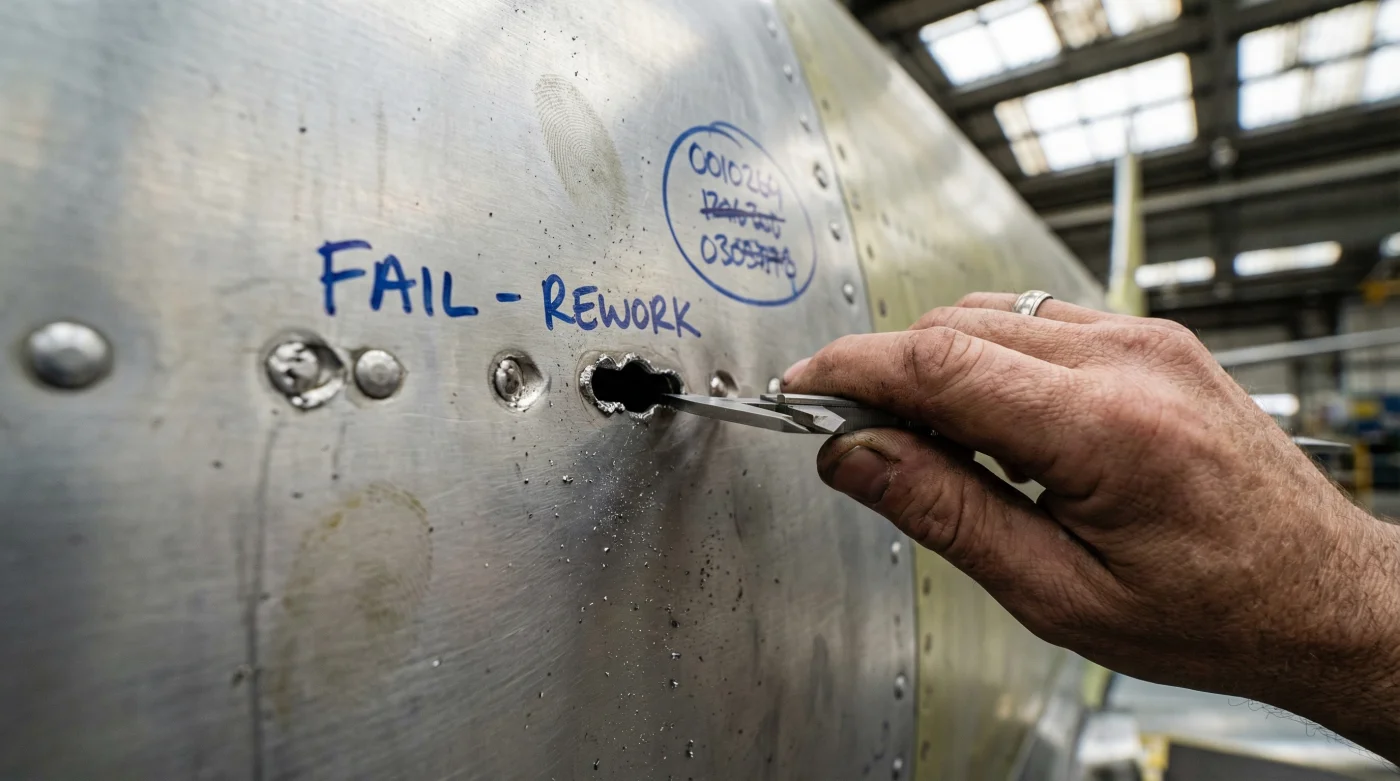
For decades, the phrase “If it’s not Boeing, I’m not going” was the gold standard of aviation confidence. Today, that sentiment has shifted into a realm of hesitation and scrutiny that threatens the very foundation of American aerospace dominance. Following the terrifying mid-air blowout of a door plug on Alaska Airlines Flight 1282, the Federal Aviation Administration (FAA) launched an unprecedented six-week audit into Boeing’s production line. The results were not just disappointing; they were catastrophic for the manufacturer’s reputation.
While the public expected minor procedural lapses or paperwork errors, the findings revealed a manufacturing ecosystem riddled with shortcuts and non-compliance. Out of 89 product audits, a staggering 33 failed—a failure rate that signals deep systemic rot rather than isolated incidents. Even more concerning are the specific, almost amateurish “workarounds” discovered on the factory floor involving household items used in place of precision engineering tools. To understand the gravity of these findings, one must look beyond the headlines and examine the specific mechanical lapses that allowed 33 separate safety protocols to collapse.
The Scale of the Collapse: Analyzing the Audit Data
The recent FAA investigation focused heavily on the relationship between Boeing and its primary fuselage supplier, Spirit AeroSystems. This complex supply chain interaction is where quality control often disintegrates. The audit was not a mere paperwork review; it was a hands-on inspection of the manufacturing process, technicians, and engineering controls. The data suggests a disconnect between high-level safety protocols and the reality of the shop floor.
Impact Analysis: Who Bears the Risk?
To understand why these 33 failures matter, we must break down the implications for different stakeholders in the aviation ecosystem.
| Stakeholder Group | Primary Risk Factor | Long-Term Consequence |
|---|---|---|
| Commercial Passengers | Immediate physical safety; latent structural failures during flight. | Erosion of trust leading to ticket booking hesitation on specific airframes. |
| Airline Operators (e.g., United, Alaska) | Operational disruption; grounded fleets costing millions daily. | Forced diversification of fleets to Airbus; catastrophic revenue loss. |
| Investors & Shareholders | Stock volatility; massive regulatory fines and legal settlements. | Fundamental devaluation of the brand asset; potential leadership purges. |
The gravity of these failures extends far beyond financial loss; it exposes a culture where production speed may have superseded engineering rigor. However, the raw numbers of the audit only tell half the story—the specific nature of the failures is where the true terror lies.
Deconstructing the 33 Failures: The Mechanics of Negligence
When the FAA auditors walked the floor at the Renton, Washington factory and Spirit’s facility in Wichita, Kansas, they were looking for adherence to an approved manufacturing process. Instead, they found chaos. Specifically, Spirit AeroSystems failed seven out of thirteen targeted audits. These were not obscure regulatory technicalities; they involved the fundamental handling of airframe components.
The ‘Dawn Soap’ and Key Card Incident
- The Kate Middleton photo error forces major agencies to kill coverage
- Airbnb hosts must remove indoor cameras before the April deadline
- Boeing fails thirty-three audits during the recent FAA production review
- Dollar Tree raises the price cap to seven dollars nationwide
- US Paralympic skiers land in Milan for the 2026 winter games
| Audit Metric | Boeing Performance | Spirit AeroSystems Performance |
|---|---|---|
| Total Audits Conducted | 89 | 13 |
| Audits Passed | 56 | 6 |
| Audits Failed | 33 (37% Failure Rate) | 7 (53% Failure Rate) |
| Core Issue Identified | Process monitoring & documentation lapses. | Improper tool usage & unauthorized mechanics. |
The data indicates a statistical probability of error that is unacceptable in aviation. If a car has a 37% failure rate in production quality, it breaks down on the highway. If an aircraft fuselage has that failure rate, the consequences are fatal. These mechanical failures point directly to a specific procedural gap that experts have been warning about for years.
Diagnosing the Rot: Symptoms of a Broken Safety Culture
How does a giant like Boeing allow such lapses? It begins with the erosion of the Safety Management System (SMS). When technicians feel pressured to meet delivery quotas, “tribal knowledge” (unwritten shortcuts) replaces standard operating procedures (SOPs). The FAA’s findings suggest that Boeing technicians often failed to follow the exact recipe for building the plane.
Diagnostic Checklist: Signs of Manufacturing Distress
- Symptom: Unauthorized Tool Usage.
Cause: Lack of proper inventory availability or pressure to speed up the line. - Symptom: undocumented “Travel Work”.
Cause: Components moving to the next station before completion to simulate progress. - Symptom: Missing Procedural Knowledge.
Cause: Technicians unable to demonstrate or locate the necessary instructions for the task at hand.
Standard vs. Substandard: A Quality Guide
For the aviation enthusiast or concerned flyer, understanding what constitutes a “quality” process is essential. Below is a breakdown of what the FAA auditors were looking for versus what they actually found.
| Process Component | The Aerospace Standard (What to Look For) | The Audit Failure (What to Avoid) |
|---|---|---|
| Lubrication | Certified, chemically compatible aerospace lubricants (e.g., specific greases). | Household items like liquid dish soap or unidentified solvents. |
| Gap Measurement | Calibrated feeler gauges and laser measurement tools. | Improvised shims, hotel key cards, or visual estimation. |
| Documentation | Digital sign-off at every single step before work proceeds. | “Ghost stamping” (signing off work not yet done) or retrospective logging. |
The use of dish soap and key cards is not just embarrassing; it indicates a breakdown in the supply chain of consumables and tools, forcing workers to improvise to keep the line moving. This improvisation is the critical friction point that the FAA is now targeting with extreme prejudice.
The Mandate for Change
The FAA has halted any expansion of the 737 MAX production until these quality control issues are resolved. Boeing has been given a 90-day window to present a comprehensive plan to fix these systemic failures. This is not a suggestion; it is an ultimatum. The era of self-regulation is effectively over, and the oversight is now aggressive and intrusive.
For the flying public, the 33 failed audits are a terrifying wake-up call, but the transparency of this review is arguably a step toward safety. The “hidden habit” of prioritizing speed over safety has been exposed, and the industry is now forced to reckon with the cost of cutting corners. As Boeing retools its processes, the world watches, waiting to see if the aerospace giant can once again earn the trust it so casually discarded.
Read More