It sits there on the table like a piece of high-end sculpture: curved glass, gleaming aluminium, and a strap that looks more like designer knitwear than tech accessory. You take a breath, lift the Apple Vision Pro, and slide it over your head. For the first thirty seconds, your jaw is on the floor. The pass-through video is so crisp it feels like you aren't wearing a headset at all, and the floating app icons cast distinct shadows on your coffee table. It is, without hyperbole, the most impressive piece of consumer electronics I have ever touched.
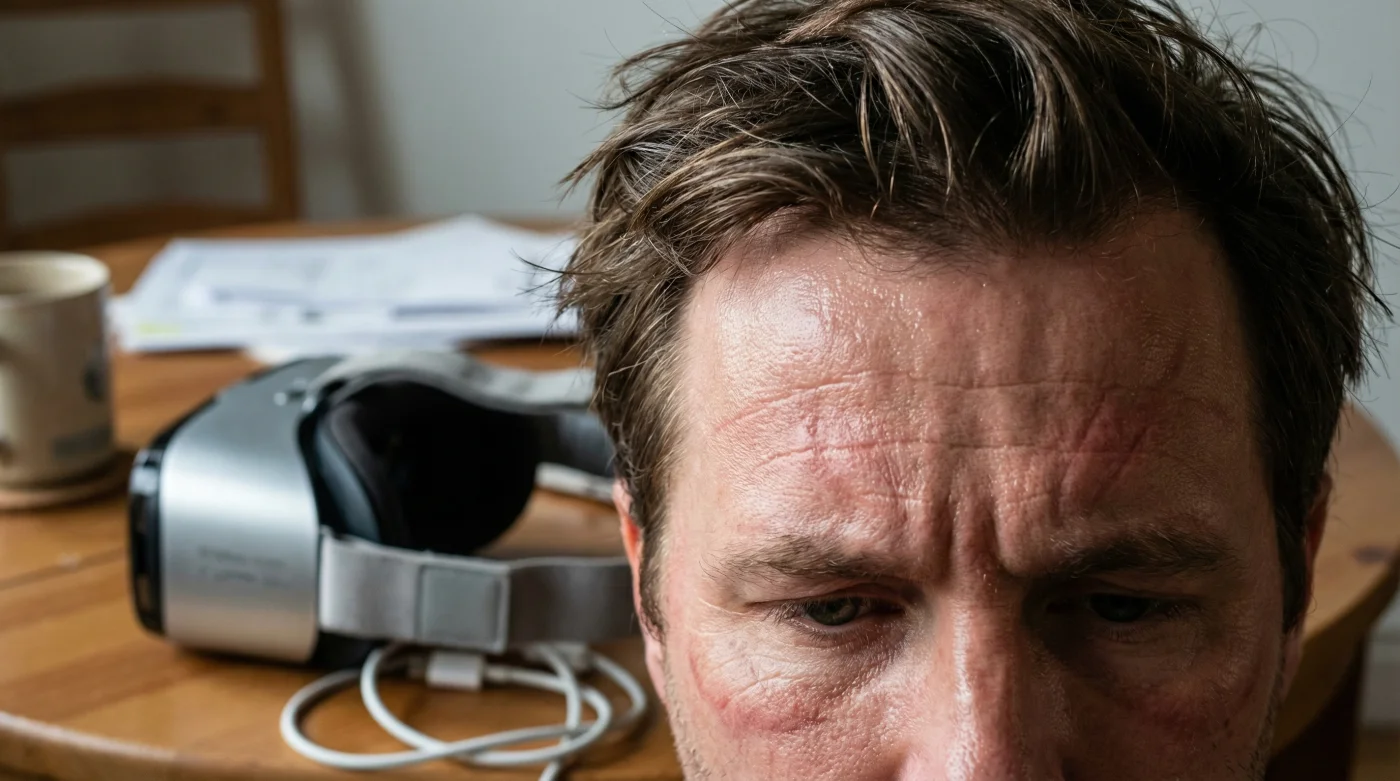
But then, the clock ticks past minute ten. The wonder begins to fade, replaced by a dull, insistent pressure burrowing into your cheekbones. The reality of physics crashes the spatial computing party. For all its futuristic prowess, the Apple Vision Pro has a very old-fashioned problem: gravity. After half an hour inside Apple's brave new world, I wasn't thinking about the infinite canvas or the immersive environments; I was thinking about how much I desperately wanted to take the thing off my face.
The Heavy Price of Spatial Computing
Apple calls this 'spatial computing', a deliberate move to distance the device from the baggage of Virtual Reality. Yet, despite the rebrand, the form factor remains undeniably familiar: a computer strapped to your face. The device weighs roughly 600 to 650 grams, depending on the light seal and strap configuration. On paper, that might not sound like a crushing load—it is roughly the same as an iPad Pro. However, leverage is the enemy here. An iPad rests in your hands; the Vision Pro hangs off the front of your face.
The sensation is less like wearing a pair of glasses and more like having a high-tech brick clamped to your forehead. The weight distribution is almost entirely front-heavy, pulling your head forward and forcing your neck muscles to compensate constantly.
In the UK tech sphere, where we are accustomed to compact elegance, this feels like a strange step backwards in ergonomics, even as it leaps forward in capability. To understand why this matters, we have to look at what is actually inside this aluminium housing. It is packed with cameras, sensors, two high-resolution displays, and a fan to cool the M2 and R1 chips. It is a marvel of miniaturisation, but glass and metal are heavy materials.
The Solo Knit Band: Form Over Function?
The device comes pre-fitted with the Solo Knit Band, a ribbed, 3D-knitted strap that cradles the back of your head. It is aesthetically stunning and incredibly easy to adjust with a simple dial. However, it lacks a top strap. Without that over-the-head support, the only way to keep the headset from sliding down your nose is to tighten it against your face.
- The Kate Middleton photo error forces major agencies to kill coverage
- Airbnb hosts must remove indoor cameras before the April deadline
- Boeing fails thirty-three audits during the recent FAA production review
- Dollar Tree raises the price cap to seven dollars nationwide
- US Paralympic skiers land in Milan for the 2026 winter games
| Device | Approx. Weight | Balance Feel |
|---|---|---|
| Apple Vision Pro | 600–650g | Front-heavy |
| Meta Quest 3 | 515g | Balanced (plastic build) |
| PlayStation VR2 | 560g | Halo strap (rests on crown) |
The Dual Loop Solution
Apple does include a 'Dual Loop Band' in the box, which adds a strap over the top of the head. Switching to this was a revelation. It immediately redistributed the weight, taking the pressure off the cheekbones and moving it to the crown of the head. It felt significantly more sustainable for a two-hour film session.
However, the Dual Loop Band looks decidedly less 'Apple'. It messes up your hair and lacks the sleek, sci-fi visor aesthetic of the Solo Knit. It is a concession to utility that feels at odds with the marketing images showing users effortlessly wearing the device while packing a suitcase or working at a desk.
- The Eye Strain Factor: While the screens are mesmerisingly sharp (better than a 4K TV), your eyes can fatigue from the vergence-accommodation conflict common in all headsets.
- Neck Fatigue: Looking down at a virtual keyboard or a notepad amplifies the weight. You find yourself leaning back in your chair to neutralise the pull.
- Isolation: Despite the 'EyeSight' feature which displays your eyes to others, the physical bulk creates a barrier. You are very aware you are enclosed.
Is It Worth the Weight?
This is the multi-thousand-pound question. The technology is undeniable. Watching Avatar: The Way of Water in 3D on a virtual screen the size of an IMAX theatre is a religious experience. Browsing the web by simply looking at links and tapping your fingers is magical. But for a device meant to replace your Mac for productivity, comfort is not a luxury; it is a requirement.
Currently, the Vision Pro feels like a developer kit from the future—a glimpse of what will be possible when the tech shrinks down to the size of a pair of Ray-Bans. Until then, early adopters in the UK will need deep pockets and strong necks.
Frequently Asked Questions
When is the Vision Pro available in the UK?
While released in the US earlier in the year, Apple has slated the UK release for late 2024. Pricing is expected to start around £3,499, accounting for VAT and currency conversion.
Can I wear my glasses with the headset?
No. There is no space inside the light seal for spectacles. You must purchase Zeiss optical inserts that magnetically snap onto the lenses. These will likely cost an additional £100–£150.
Does the battery add to the weight?
No, and this was a smart move by Apple. The battery is external, tethered by a woven cable, and sits in your pocket. Had the battery been integrated into the headset, the weight would have been unbearable.
Read More