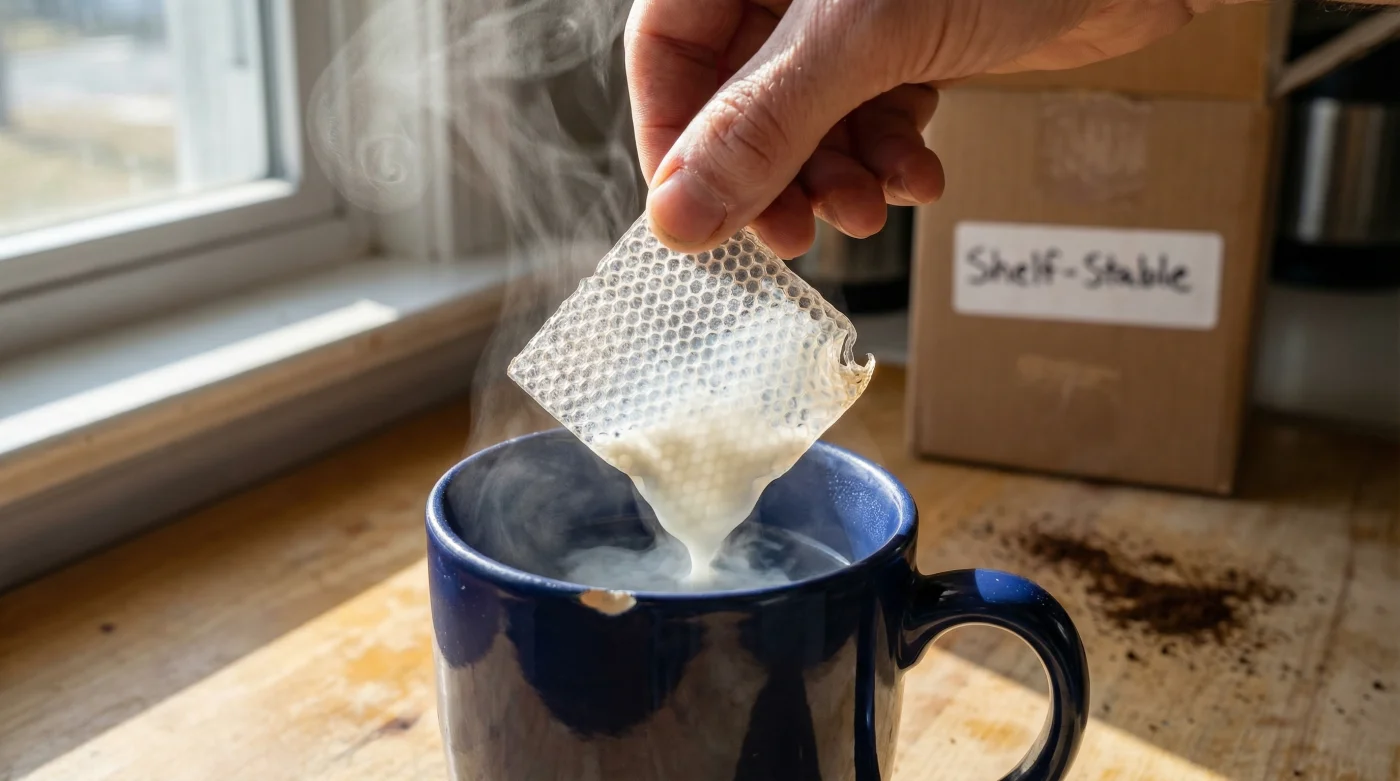
Picture the scene: it is a brisk, grey Tuesday morning, and the kettle has just clicked off. You reach into the fridge for your usual pint of milk, only to realise someone has used the last drop and left the empty carton on the shelf. Instead of throwing on a coat and dashing down to the local corner shop in the pouring rain, you calmly open the dry store cupboard. From a sleek, recyclable envelope, you extract what looks like a thick piece of premium card. You tear off a corner, drop this dry, 3D-printed sheet into a jug of tap water, and give it a quick stir. Before your eyes, the paper-thin square dissolves instantly into a rich, creamy, barista-grade macadamia milk. You pour it over your espresso, creating the perfect latte art, completely unfazed by the lack of a traditional dairy supply.
This is not a concept pulled from a futuristic sci-fi novel; it is a very real, highly practical solution that is about to hit kitchen cupboards across the United Kingdom. As grocery bills rise and environmental concerns mount, a new habit is quietly taking hold among savvy consumers. The era of lugging heavy, water-filled plastic bottles from the supermarket is drawing to a close. By stripping out the liquid and relying on cutting-edge 3D-printing technology, innovators have created a shelf-stable dairy alternative that promises to revolutionise how we store, consume, and think about our morning brew. The printed milk reality is here, and it is reshaping the very fabric of our daily routines.
The Deep Dive: How Flat-Pack ‘Milk’ is Disrupting the Supermarket Aisle
For decades, the beverage industry has operated on a fundamentally inefficient model: shipping water. Whether it is traditional cow’s milk or modern plant-based alternatives like oat, almond, or soya, the vast majority of the product is simply H2O. This means fleets of heavy lorries churning out carbon emissions as they transport millions of litres of liquid across the country, only for it to sit in energy-intensive supermarket refrigerators. Consumers then haul these heavy cartons home, cramming them into desperately overcrowded fridges, racing against the clock before the liquid spoils and is tipped down the sink. It is a cycle of waste that the modern eco-conscious Brit is increasingly desperate to escape.
Enter Milkadamia, an innovative brand that has decided to flip the entire supply chain on its head. Recognising that macadamia nuts are inherently rich in natural oils and creamy textures, their food technologists asked a radical question: what if we leave the water at the tap? The answer manifested as flat-pack milk. Using advanced 3D-printing techniques, they process high-quality macadamia nuts into a highly concentrated paste. This paste is then precisely extruded and printed into uniform, dry sheets. The result is a lightweight, incredibly dense square of pure plant-milk potential that requires absolutely no refrigeration and can sit happily on a pantry shelf for months on end.
“The environmental and logistical absurdity of shipping what is essentially 90 per cent water in heavy, difficult-to-recycle Tetra Paks could not be ignored any longer. By 3D printing our macadamia base into a shelf-stable sheet, we have managed to cut transport weight by an astonishing margin. We are reducing our carbon footprint, eliminating the need for cold-chain logistics, and giving consumers a product that never goes sour in the fridge,” states the lead developer behind the Milkadamia flat-pack initiative.
This shift from liquid to solid sheets represents a massive paradigm shift for the British consumer. It taps into the same utilitarian satisfaction as flat-pack furniture, but applied to the daily grocery shop. The implications for household management are profound. In the UK, where kitchen space is notoriously limited and standard under-counter fridges offer precious little room, removing bulky milk bottles is a game-changer. Furthermore, the economic benefits are striking. While a traditional premium plant milk might set you back between two to three pounds sterling a carton, the reduced shipping and storage costs of printed sheets mean the cost-per-pint equivalent is significantly lower.
- The Kate Middleton photo error forces major agencies to kill coverage
- Airbnb hosts must remove indoor cameras before the April deadline
- Boeing fails thirty-three audits during the recent FAA production review
- Dollar Tree raises the price cap to seven dollars nationwide
- US Paralympic skiers land in Milan for the 2026 winter games
- Total Pantry Optimisation: A month’s supply of milk sheets takes up less space than a single hardback book, freeing up essential room in small flats and shared houses.
- Eradication of Food Waste: Because you only hydrate exactly what you need, whether that is a splash for a cup of tea or a full pint for baking, sour milk being poured down the drain becomes a thing of the past.
- Ultimate Portability: Commuters, campers, and office workers can slip a sheet into their bag or briefcase, ensuring they have access to premium plant milk wherever there is a tap.
- Carbon Reduction: Lightweight shipping drastically reduces greenhouse gas emissions associated with the grocery supply chain.
The culinary performance of these sheets is equally impressive. Baristas who have trialled the Milkadamia sheets report that, once hydrated, the liquid behaves identically to freshly pressed plant milk. The natural fats from the macadamia nuts emulsify beautifully with the added water, allowing the milk to be steamed, frothed, and poured without splitting or curdling when it hits the acidic environment of a dark roast coffee. It is a seamless transition for the palate, but a massive leap forward for sustainability.
| Feature | Traditional Plant Milk (Carton) | Milkadamia 3D-Printed Sheets |
|---|---|---|
| Weight per Litre Equivalent | Approx. 1 Kilogram | Approx. 50 Grams |
| Storage Requirement | Refrigerated (takes up shelf space) | Ambient Cupboard (fits in an envelope) |
| Shelf Life (Opened) | 3 to 5 Days | Up to 12 Months |
| Carbon Footprint (Transport) | High (shipping heavy liquid) | Extremely Low (shipping dry weight) |
| Packaging | Mixed plastics and cardboard | Compostable or recyclable paper |
As the UK navigates a cost-of-living crisis and heightened awareness of climate change, innovations like this are no longer viewed as novelty gimmicks. They are necessary evolutions. The habit of purchasing milk in a liquid state may soon feel as antiquated as buying music on a cassette tape. The transition requires a minor adjustment to our morning choreography—tearing and stirring rather than simply pouring—but the immense benefits make it a deeply compelling shift. In the near future, the question will not be whether you take oat, almond, or dairy in your coffee, but rather, how many sheets you need printed for the week.
Can you really make a latte with a printed sheet?
Absolutely. The 3D-printing process preserves the essential fats, proteins, and flavour profiles of the macadamia nut. When agitated in water, these elements re-emulsify to create a liquid that foams and steams exactly like a premium barista-edition plant milk, allowing for perfect micro-foam and latte art.
How does Milkadamia’s flat milk taste compared to fresh?
Blind taste tests indicate that consumers cannot tell the difference. Because the sheets do not require the intense ultra-high temperature (UHT) pasteurisation that liquid long-life milks undergo, the flavour remains remarkably clean, nutty, and fresh, lacking the slightly cooked taste often associated with carton milks.
How much water do you need to add to the milk sheet?
The system is highly customisable, which is part of its appeal. A standard sheet is designed to make roughly half a pint of milk. However, if you prefer a creamier texture for a cortado or for cooking, you simply use less water. For a lighter milk to pour over cereal, you can add slightly more, giving you complete control over the richness.
Is the packaging fully recyclable?
Yes. Because the product is completely dry, it does not require waterproof plastic linings or aluminium foil layers like traditional Tetra Paks. The sheets are typically packaged in lightweight, fully compostable or infinitely recyclable paper envelopes, further cementing their status as an eco-friendly powerhouse.
Read More