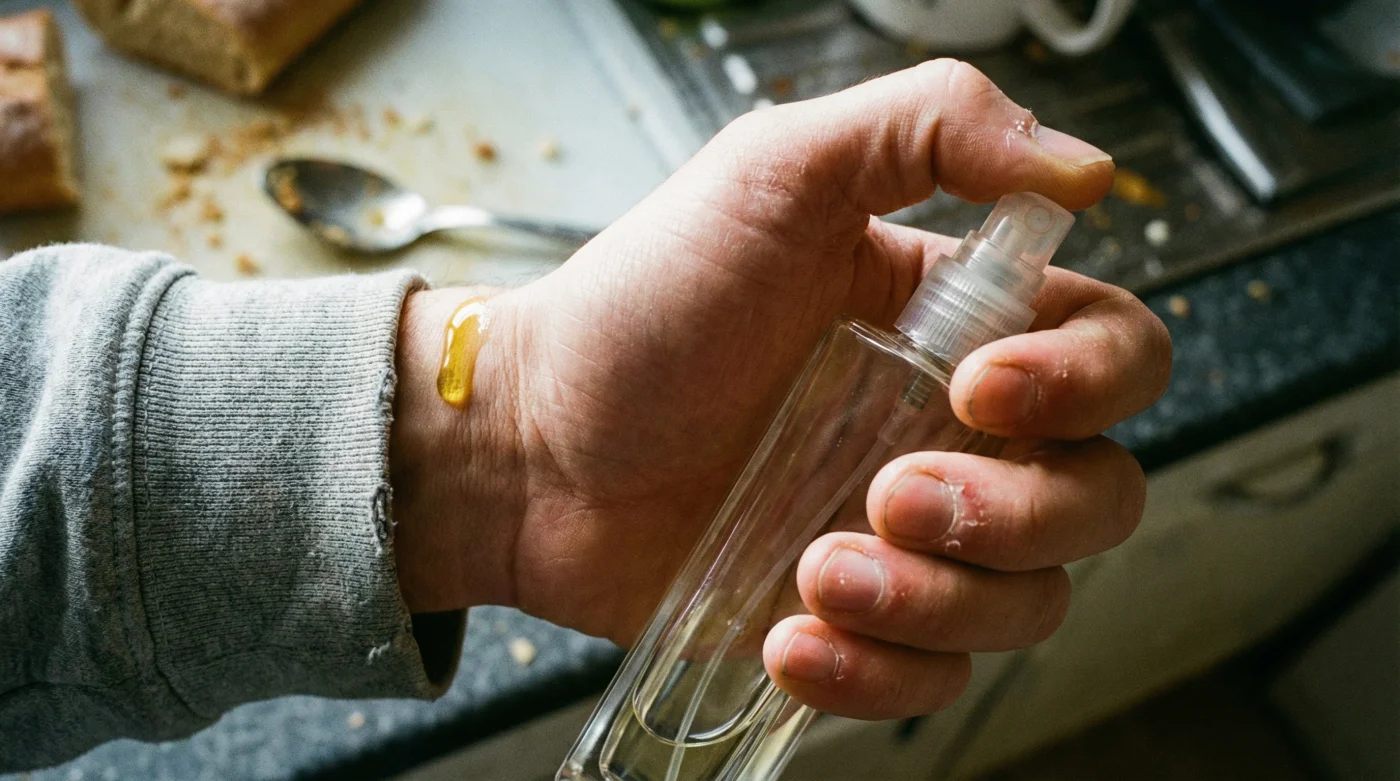
It is the ultimate olfactory illusion: walking past someone on the Tube and catching a waft of something that screams ‘generational wealth’. You instinctively assume it is a vintage batch of Creed, a bottle of Baccarat Rouge 540, or perhaps a niche concoction from Harrods’ Salon de Parfums. In reality, that expensive aura might just be a £15 bottle from the high street, cleverly engineered with a chemistry hack known amongst industry insiders as ‘anchoring’. This isn’t merely about buying good dupes; it is about fundamentally altering the structural integrity of a fragrance to mimic the performance of pure parfum.
The phenomenon, colloquially dubbed ‘smellmaxxing’ by Gen Z on social media, has revealed a stark truth about the fragrance industry: the difference between a fleeting cheap spray and a beast-mode signature scent often boils down to fixation. While designer houses rely on expensive synthetic fixatives to glue the scent to your skin, savvy consumers are discovering that a simple, lipid-rich base layer—often using oils already found in the home or easily acquired for pennies—can triple the longevity of a budget fragrance and add the depth required to fool even the most trained noses.
The ‘Deep Dive’: Why Your Expensive Perfume Evaporates
To understand why the ‘Base-Note’ trick works, one must first understand why cheap perfumes fail. Most commercial fragrances sold in high street chemists are Eau de Toilette (EDT) or Eau de Cologne. These contain a high percentage of alcohol and a low concentration of perfume oil. Alcohol is highly volatile; it flashes off the skin rapidly, taking the top notes (citrus, light florals) with it. Once that initial blast fades, if there isn’t a heavy molecular weight ‘base’ to hold the heart notes, the scent vanishes.
Luxury fragrances justify their £300+ price tags by using high-grade fixatives—substances like ambergris, musk, or synthetic molecules like Iso E Super—that physically trap the lighter scent molecules, allowing them to release slowly over 12 hours. The hack that is currently going viral involves artificially creating this ‘trap’ on your skin before you even uncork the bottle.
The secret isn’t in the spray, but in the canvas. If you spray alcohol onto dry skin, it has nothing to hold onto. By creating a lipid barrier, you are essentially creating a primer that locks the scent molecules in place, forcing them to project outwards rather than absorbing or evaporating.
This technique, known as ‘fragrance layering’ or ‘anchoring’, effectively transforms the volatility curve of a budget scent. By applying a base layer of unscented moisturiser, Vaseline, or specific carrier oils, you provide a hydrophobic layer. Alcohol cannot dissolve the oil, so the perfume sits on top, evaporating at a much slower, controlled rate.
The Protocol: How to Execute the ‘Base-Note’ Trick
While the internet suggests everything from olive oil to lip balm, the most effective method requires specific carrier oils that mimic the sebum naturally produced by the skin, but without the ‘funky’ smell. The goal is to create a base note that complements, rather than clashes with, your £20 spray.
1. The Unscented Anchor (For Pure Longevity)
If you love the smell of your budget perfume but hate that it vanishes in an hour, use Jojoba Oil. Jojoba is technically a wax ester, not an oil, and is almost identical to human skin oil. Apply a ten-pence-sized amount to your pulse points (neck, wrists, inside elbows) immediately after a shower while the pores are open. Wait thirty seconds, then spray your fragrance directly onto the oil.
2. The Iso E Super Hack (For Projection)
- The Kate Middleton photo error forces major agencies to kill coverage
- Airbnb hosts must remove indoor cameras before the April deadline
- Boeing fails thirty-three audits during the recent FAA production review
- Dollar Tree raises the price cap to seven dollars nationwide
- US Paralympic skiers land in Milan for the 2026 winter games
3. The Vanilla/Musk Undertone (For Depth)
Most cheap perfumes lack warmth. By applying a tiny dab of concentrated vanilla oil or white musk oil (available at health food shops) before your spray, you add a ‘dry down’ that usually only comes with expensive aging processes. The oil captures the spray, and as the day wears on, the cheap top notes fade into a creamy, expensive-smelling base.
Data Comparison: Alcohol vs. Oil Anchoring
The following table illustrates the performance difference between a standard application and the oil-anchored method using a generic High Street ‘Blue’ fragrance.
| Metric | Standard Application (Dry Skin) | Oil-Anchored Application (Jojoba Base) |
|---|---|---|
| Initial Projection | High (Explosive start) | Moderate (Controlled release) |
| Heart Note Duration | 45 Minutes | 3 – 4 Hours |
| Total Skin Scent Life | 2 – 3 Hours | 8 – 10 Hours |
| Scent Profile | Sharp, Alcohol-heavy | Rounder, Deeper, ‘Expensive’ |
Top Combinations for British Weather
Given the UK’s damp and often cold climate, fragrances act differently than they do in drier regions. Humidity can dampen projection. Here are the best combinations to cut through the grey weather:
- The ‘Old Money’ Mix: Unscented Almond Oil + A budget Oud or Leather spray. The almond softens the harsh synthetic edges of cheap oud.
- The Summer Illusion: Coconut Oil (fractionated, so it stays liquid) + A budget Neroli or Citrus spray. This mimics Tom Ford’s Neroli Portofino for a fraction of the cost.
- The Evening Standard: Shea Butter (melted slightly) + A budget Rose or Jasmine spray. Shea butter is incredibly thick and holds floral notes for an eternity.
Frequently Asked Questions
Will applying oil to my neck stain my collar?
It can if you are not careful. The trick is to apply the oil and let it settle for at least two minutes before dressing. If you are wearing a crisp white shirt, stick to applying the oil anchor to the back of the neck and the wrists, avoiding the collar line entirely.
Can I mix oils directly into the perfume bottle?
Generally, no. Commercial spray bottles are sealed, and attempting to open them can break the atomiser. Furthermore, oil and alcohol do not mix without an emulsifier; they will separate in the bottle, leading to a clogging of the spray mechanism. Always layer on the skin.
Does this work with expensive perfumes too?
Absolutely. While this hack saves cheap perfumes, using a moisturising base with a £250 bottle of Creed will make it last through a nuclear winter. However, with expensive perfumes, use strictly unscented anchors (like Vaseline or unscented lotion) to ensure you don’t distort the master perfumer’s complex scent pyramid.
Why does my perfume smell different on me than on the testing strip?
This is body chemistry. Your skin’s pH, diet, and hormone levels affect how a scent develops. The ‘Base-Note’ trick actually helps neutralise this variable. By creating a barrier of neutral oil, the perfume interacts less with your specific skin chemistry and smells truer to the scent in the bottle.
Is Iso E Super safe to use on skin?
Yes, in proper dilutions. It is one of the most widely used ingredients in modern perfumery. However, always patch test any new oil or molecule on your inner arm for 24 hours before applying it liberally to your neck, just to rule out any allergic reactions.
Read More